Books for Ages 10–14
Climate Fiction for Middle Grade Readers
10/08/26 11:50 Filed in: Environmental Education
Climate Fiction for Middle Grade Readers
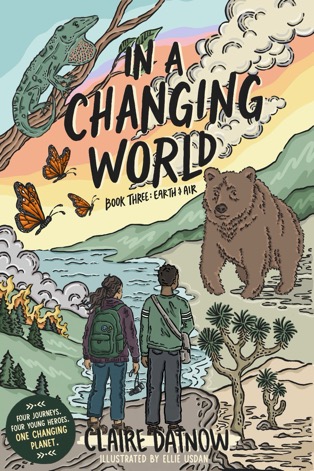
In a Changing World: Climate Adventures for Ages 10–14 That Show How Nature Adapts—and How Young People Can Make a Difference
What inspired me to write climate adventures for middle grade readers ages 10–14?
I’m fascinated by new scientific discoveries—especially what scientists are learning about our changing planet. Every day, researchers gather evidence about how climate change is affecting wildlife, ecosystems, and communities, and what those changes may mean for the future.
But scientific facts alone don’t always make us feel what is happening.
Stories can.
Through novels, movies, and television, science can become personal and emotionally meaningful. That’s why I write climate fiction for upper elementary and middle grade readers ages 10–14. I weave nature adventure and scientific mystery together to show young readers something remarkable: the natural world is already responding and adapting to climate change.
And perhaps we can learn from nature.
For teachers, librarians, families, and young readers, these stories offer an adventurous way to explore climate science, wildlife, adaptation, conservation, and the choices we can make in a changing world.
Why do animals and wildlife play such an important role in my books?
No matter the setting or theme, wildlife finds its way into my stories. I’m constantly reading about animals, ecosystems, conservation, and new scientific discoveries that I can weave into my eco-adventures.
In In a Changing World, young readers encounter monarch butterflies, Kodiak brown bears, anole lizards, and Joshua trees. Each story begins with a mystery inspired by real science:
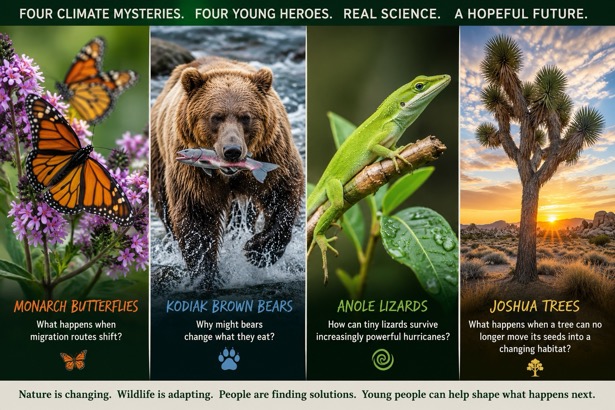
What happens when familiar migration routes shift?
Why might bears change what they eat?
How can tiny lizards survive increasingly powerful hurricanes?
And what happens when a tree can no longer move its seeds into a changing habitat?
These real-world mysteries allow me to explore not only the effects of climate change, but also adaptation, resilience, biodiversity, and successful conservation efforts.
How would you describe your climate fiction?
My stories are part climate fiction, part mystery, and part nature adventure.
Climate change is such an enormous subject that it can feel difficult—even overwhelming—for young readers. Instead of beginning with the enormity of the problem, I begin with something they can see and wonder about.
Why are there fewer butterflies this summer?
Why are bears changing their diets?
How could a tiny anole lizard survive a monster hurricane?
These questions turn climate science into mysteries young characters—and young readers—can investigate. Through adventure and discovery, the larger picture gradually emerges.
My goal is to help children understand the seriousness of climate change without overwhelming them with fear.
How do you write hopeful climate-action stories?
I focus on two things: solutions and young heroes.
My protagonists are curious, determined young people who ask questions, investigate mysteries, make mistakes, discover evidence, and ultimately find ways to help.
Just as importantly, I want young readers to imagine a future in which solutions are possible—communities restoring habitats, scientists and citizens working together, renewable energy becoming part of everyday life, and young people contributing ideas of their own.
Children hear plenty about what could go wrong with our planet. They also deserve stories that help them imagine what could go right.
Climate hope doesn’t mean pretending the problems aren’t serious. It means showing that knowledge, creativity, conservation, and collective action can make a difference.
Who Are These Climate Adventures For?
Teachers and homeschool educators: The stories can spark discussions about climate science, biodiversity, wildlife adaptation, conservation, resilience, and problem-solving—while giving students mysteries and adventures they actually want to read.
Librarians: In a Changing World offers adventure-driven environmental fiction for readers ages 10–14 who enjoy animals, mysteries, science, nature, and stories about young people making a difference.
Parents and grandparents: These climate adventures provide a hopeful way to introduce young readers to environmental challenges without overwhelming them with fear. They can also open conversations between generations about wildlife, nature, and our changing planet.
Environmental organizations and nature centers: Climate fiction can complement environmental education and youth outreach by turning real scientific research and conservation challenges into stories young people can connect with emotionally.
Young readers: Most of all, these are adventures—filled with hurricanes, bears, butterflies, lizards, mysteries, danger, discovery, and young people determined to find answers.
Teachers and librarians can also explore my Discussion Questions and educational resources for ways to extend the stories beyond the page.
Can climate mysteries inspire kids to become part of the solution?
I believe stories can plant that first seed.
Over twenty-five years as a published author, I’ve seen how deeply young readers can connect with fictional characters. When they care about what happens to a character, an animal, or a place, complicated environmental issues suddenly become personal.
Learning about climate science has changed me, too. The more I understand, the less helpless I feel. Instead of seeing only problems, I can see choices, possibilities, and solutions.
That is what I hope readers ages 10–14 take away from In a Changing World.
Nature is changing. Wildlife is adapting. People are finding solutions. And young people can help shape what happens next.
For teachers, librarians, families, and young readers, I hope these climate adventures offer something beyond information: curiosity, courage, and a reason to believe that a more hopeful future is still ours to create.
Discover In a Changing World
Four climate mysteries. Four young heroes. Real science. One hopeful message: nature can adapt—and so can we.
Written for readers ages 10–14, In a Changing World combines mystery, wildlife, science, adventure, and climate solutions to show young readers that the future isn’t something they simply inherit—they can help shape it.
Explore
In a Changing World
Teacher discussion and questions
Meet Claire Datnow