Conservation Gives Us Hope
“Little drops of water,
Little grains of sand,
Make the mighty ocean
And the pleasant land.”
—Julia A. F. Carney
Picture determined volunteers removing bags of litter from a creek before it travels farther downstream. Hear the joyful shouts of students planting a pollinator garden. Imagine scientists and students testing water quality, neighbors planting native trees, and volunteers restoring wetlands by removing invasive plants. This brings back happy memories of my middle grade students at the Birmingham Public School.
Or these students creating rain gardens that help slow and filter stormwater. Or planting native trees and wildflowers to provide wildlife habitat and helps hold the soil in place.
All the activities contribute to a shared goal: protecting the natural world around us. Now, imagine how all of these local actions can benefit places far beyond the neighborhoods where they begin—Little drops of water. Little grains of sand.
Here in Alabama, we can see this spirit at work through many organizations that bring people together around a place, a species, or a shared concern. For example Alabama Audubon’s annual Black Belt Birding Festival introduces visitors to the region’s birds, landscapes, and heritage while supporting bird-based ecotourism. The festival is part of its broader Black Belt Birding Initiative, connecting appreciation for nature with opportunities for local communities (alaudubon.squarespace.com, alaudubon.org)
Other organizations contribute in different but complementary ways. Freshwater Land Trust conserves land and water in Central Alabama. Citizens’ Climate Lobby encourages people to work together to implement climate policy. The Nature Conservancy works locally and internationally to protect the land and water.
In addition, all these organizations create a powerful network of shared knowledge, resources, and experience. Nature itself reminds us why these connections matter: rivers cross state lines, migrating birds cross continents, and air moves freely across borders—little grains of sand create a pleasant land.
Education is an essential part of this work. People of every age need opportunities to discover the natural world around them, understand the threats it faces, and learn then how to help. For example, Jefferson County Greenways offers outdoor field trips and opportunities to explore places including Red Mountain Park, Ruffner Mountain, and Turkey Creek Nature Preserve. The Environmental Education Association of Alabama connects educators who help people to understand and care for the natural world.
A child’s first close look at a bird, a family’s walk through a wetland, or a teacher’s outdoor lesson can begin a lifelong interest. Citizen science offers another way to participate: observing wildlife, recording changes, and contributing information that can support research. Understanding grows through experience, and concern can become purposeful action.
That strong connection between understanding and action is what inspires me to write eco-fiction and climate fiction for young readers. Through mystery, adventure, and scientific discovery, I invite readers to imagine themselves working with friends, scientists, and their communities to protect the world around them. My stories are my own small contribution.
Our planet—earth, air, water and fire are all connected. That’s what I had in mind when I created The Four Elements Climate Trilogy: these four elements depend on one another to sustain life and balance nature. And the four elements—earth, air, water and fire are all connected to one another to sustain life and keep nature that we depend upon in balance. That’s exactly what I had in mind when I created The Four Elements Climate Trilogy:


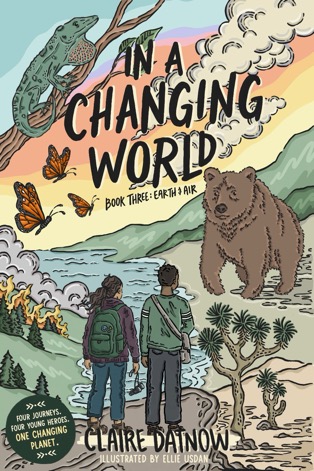
Beginning with Red Flag Warning, Book 1: Fire, the trilogy brings environmental challenges into young people’s lives through characters who face danger, ask questions, learn about science and despite facing challenges are inspired to take action. I want my young readers to recognize that they, too, have something to contribute. To explore book two, The Gray Whale’s Lament, and book 3, in a changing world visit clairedatnow.com
Yet this larger picture of collective effort can be difficult to see in everyday news coverage. Fires, floods, and environmental destruction make dramatic headlines. The patient work of restoring habitat, protecting a watershed, or educating a generation unfolds over years. Its stories are scattered, making it harder to recognize how much they add up to.
We need to understand the dangers of inaction. We also need to hear about the people responding to them—their progress, their persistence, and the lessons they can share. All of their work give us reasons to stay involved.
Community events can help make that work visible. The Cahaba River Coalition’s Frydown brings people together to celebrate the river and support conservation. Visitors leave such gatherings with more than happy memories: perhaps a new interest, a volunteer opportunity, or the decision to join an environmental organization. Each of us can choose a place to begin. Volunteer with a local group. Plant native vegetation. Support environmental education. Help protect a nearby stream. Invite someone else to join you
Hope grows when we recognize the work already underway and find our own place within it. Like little drops of water and little grains of sand, our contributions become part of something larger—a shared effort to leave a healthier, more vibrant Earth for generations to come.
A child’s first close look at a bird, a family’s walk through a wetland, or a teacher’s outdoor lesson can begin a lifelong interest. Citizen science offers another way to participate: observing wildlife, recording changes, and contributing information that can support research. Understanding grows through experience, and concern can become purposeful action.
That connection between understanding and action is why I write climate fiction for young readers. My stories are my own small contribution—another drop of water, another grain of sand. Through mystery, adventure, and scientific discovery, I invite readers to imagine themselves working with friends, scientists, and their communities to protect the world around them.
The traditional elements—earth, air, water, and fire—give The Four Elements Climate Trilogy its framework for exploring our interconnected world. Beginning with Red Flag Warning, Book 1: Fire, the trilogy brings environmental challenges into young people’s lives through characters who face danger, ask questions, and discover reasons to act. I want readers to recognize that they, too, have something to contribute.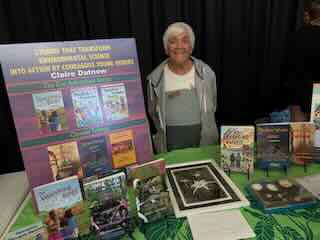
Exhibit at Cahaba River Coalition Frydown
Yet this larger picture of collective effort can be difficult to see in everyday news coverage. Fires, floods, and environmental destruction make dramatic headlines. The patient work of restoring habitat, protecting a watershed, or educating a generation unfolds over years. Its stories are scattered, making it harder to recognize how much they add up to.
We need to understand the dangers. We also need to hear about the people responding to them—their progress, their persistence, and the lessons they can share. These stories give us reasons to stay involved. Community events can help make that work visible. The Cahaba River Coalition’s Frydown brings people together to celebrate the river and support conservation. I hope visitors leave such gatherings with more than happy memories: perhaps a new interest, a volunteer opportunity, or the decision to join an environmental organization. (frydown.com)
Each of us can choose a place to begin. Volunteer with a local group. Plant native vegetation. Support environmental education. Help protect a nearby stream. Invite someone else to join you.
Hope grows and shines when we recognize the work already underway and find our own place within it. Like little drops of water and little grains of sand, our contributions become part of something larger—a shared effort to leave a healthier, more vibrant Earth for generations to come.
Organizations listed:
Alabama Audubon Society
The Cahaba River Coalition
Jefferson County Greenways
Nature Conservancy
Citizen Science Climate Lobby
Ruffner Mountain Nature Center
Freshwater Land Trust
Environmental Education Association of Alabama
Back to Home Page
Cli-Fi Eco Adventures Middle Grade
I’m sharing events I plan to attend, some past events, and freebies that you may be interested in. But first a teaser: Do you know the meaning of the words Phenology and Biomimicry? Look for the answer below:

Claire chatting with a Black Vulture
- Upcoming events:
- Are you planning to attend the Southern Breeze Spring Mingle, in Decatur, Georgia, March 25-29. Decatur, Georgia, Library? If so, please email me so we can make plans to meet at the conference. Also I would love you to visit me at the Book Launch for my newest books in The Adventures of the Sizzling Six series.
Free materials;
I recently presented a workshop, ‘Drawn from Nature,” at the Environmental Education Association of Alabama Conference at Guntersville. Free materials: Let me know if you are interested in receiving an outline. In addition, you are interested in receiving an outline of my presentation “Preserving The Rich Bio Diversity of the Southern States,” please email me.
World Migratory Bird Day2025 is just around the corner! World Migratory Bird Day is officially celebrated on the second Saturday in May (May 10th in 2025). If you are interested in participating in this event please let me know!
April Earth Month: for Events you can attend visit Bham Now: https://bhamnow.com/2018/04/03/earth-month/?amp Three of Birmingham’s leading nature education organizations, Ruffner Mountain Nature Preserve, Turkey Creek Nature Preserve and the Birmingham Botanical Gardens are holding Spring Plant Sales on consecutive weekends in April. Both events raise monies for important nature education programs.
- Alabama Writers Cooperative: The AWC Annual Conference. September 12-14, 2025 ORANGE BEACH, AL. Registration and schedule information coming soon. Be on the look out: Visit: https://alabamawriterscooperative.org/
- Phenology and Biomimicry
Answer: “Phenology is the study of the timing and cyclical patterns of events in the natural world, particularly those related to the annual life cycles of plants, animals, and other living things.” USA National Phenology Network
Answer: “Biomimicry, or biomimetics, is the practice of learning from and emulating nature's designs and strategies to solve human problems and create sustainable solutions.” The Biomimicry Institute
https://biomimicry.org › Get Inspired

Field Workshop
At the Conference: I participated in fascinating workshops that bring these terms to life. Coincidentally, I am working on the third book in The Four Elements Trilogy, which includes species like the green anole, a lizard, that scientists and engineers have applied to create the latest technology—for example the bullet train and adhesives.
- Congratulations! Alabama Writers Cooperative is honored to announce that they will be the first recipient of the Jeanie Thompson Champion of The Literary Art Award, presented by the Alabama Writer’s Forum. I am so look forward to attending the Gala March 11. As a long time member on the board this was special to me.

Claire & Big with Dr. Gillstrap
Words to Add to Our Vocabulary: Phenology and Biomimicry.
I recently attended the awesome! Environmental Education Association of Alabama Conference at Guntersville State Park. There I participated in fascinating workshops that bring these terms to life. Coincidentally, I am working on the third book in The Four Elements Trilogy, which includes species like the green anole, a lizard, that scientists and engineers have applied to create the latest technology—for example the bullet train and adhesives. Here are a few events to attend:
Here are a few events to attend:
April is Earth Month. Events you can attend visit Bham Now: https://bhamnow.com/2018/04/03/earth-month/?amp Three of Birmingham’s leading nature education organizations, Ruffner Mountain Nature Preserve, Turkey Creek Nature Preserve and the Birmingham Botanical Gardens are holding Spring Plant Sales on consecutive weekends in April. Both events raise monies for important nature education programs.
Writer Events: If you are a writer, an environmental educator or love to explore the nature, here are a few Up Coming Events:
For Writers and Nature Lovers.
- Southern Breeze Spring Mingle, Decatur, Georgia, March 25-29. Decatur, Georgia, Library. And Book Launch for my newest books in The Adventures of the Sizzling Six series.
Past events
- Alabama Writers Cooperative: The AWC Annual Conference. September 12-14, 2025 ORANGE BEACH, AL. Registration and schedule information coming soon. Be on the look out!
- Congratulations! Alabama Writers Cooperative is honored to announce that they will be the first recipient of the Jeanie Thompson Champion of The Literary Art Award, presented by the Alabama Writer’s Forum. I am so look forward to attending the Gala March 11.
https://alabamawritingworkshop.com/
My Book Launches:
- Southern Breeze Spring Mingle, Decatur, Georgia, March 25-29.

For More Fun Photos Visit: medicament.net