Claire Datnow
In a Changing World: Climate Fiction Adventures for Middle Grade Readers
10/08/26 11:50 Filed in: Environmental Education
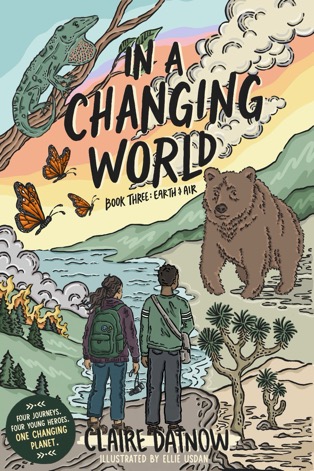
ISBN: 978-0-9969446-7-0
In a Changing World: Middle Grade Climate Fiction, Wildlife & Adventure
August 10, 2026
An Interview with Author Claire Datnow
I’m fascinated by new scientific discoveries—especially what scientists are learning about our changing planet. Every day, researchers gather evidence about how climate change is affecting wildlife, ecosystems, and communities, and what those changes may mean for the future.
But scientific facts alone don’t always make us feel what is happening.
Stories through novels, movies, television, and science can become personal and emotionally meaningful. That’s what I strive to do when I write climate fiction for upper elementary and middle grade readers ages 10–14. I weave nature adventure and scientific mystery together to show young readers something remarkable: the natural world is already responding and adapting to climate change.And perhaps we can learn from nature.
For teachers, librarians, families, and young readers, these stories offer an exciting and adventurous way to explore climate science, wildlife, adaptation, conservation, and the choices we can make in a changing world.
Why do animals and wildlife play such an important role in my books?
No matter the setting or theme, wildlife finds its way into my stories. I’m constantly reading about animals, ecosystems, conservation, and new scientific discoveries that I can weave into my eco-adventures.
In a Changing World, young readers encounter monarch butterflies, Kodiak brown bears, anole lizards, and Joshua trees. Each story begins with a mystery inspired by real science:
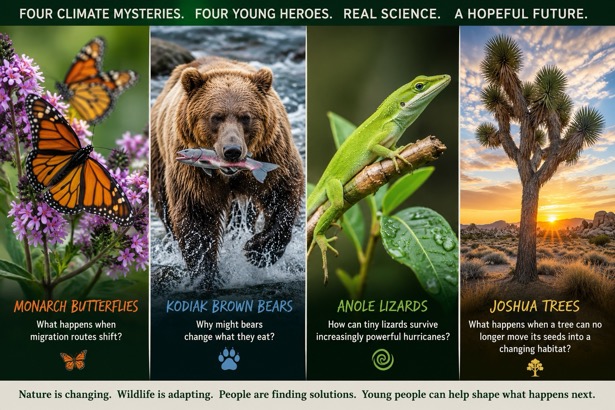
What happens when familiar migration routes shift?
Why might bears change what they eat?
How can tiny lizards survive increasingly powerful hurricanes?
And what happens when a tree can no longer move its seeds into a changing habitat?
These real-world mysteries allow me to explore not only the effects of climate change, but also adaptation, resilience, biodiversity, and successful conservation efforts.
How would you describe your climate fiction?
My stories are part climate fiction, part mystery, and part nature adventure.
Climate change is such an enormous subject that it can feel difficult—even overwhelming—for young readers. Instead of beginning with the enormity of the problem, I begin with something they can see and wonder about.
Why are there fewer butterflies this summer?
Why are bears changing their diets?
How could a tiny anole lizard survive a monster hurricane?
These questions turn climate science into mysteries young characters—and young readers—can investigate. Through adventure and discovery, the larger picture gradually emerges.
My goal is to help children understand the seriousness of climate change without overwhelming them with fear.
How do you write hopeful climate-action stories?
I focus on two things: solutions and young heroes.
My protagonists are curious, determined young people who ask questions, investigate mysteries, make mistakes, discover evidence, and ultimately find ways to help.
Just as importantly, I want young readers to imagine a future in which solutions are possible—communities restoring habitats, scientists and citizens working together, renewable energy becoming part of everyday life, and young people contributing ideas of their own.
Children hear plenty about what could go wrong with our planet. They also deserve stories that help them imagine what could go right.
Climate hope doesn’t mean pretending the problems aren’t serious. It means showing that knowledge, creativity, conservation, and collective action can make a difference.
Who Are These Climate Adventures For?
Teachers and homeschool educators: The stories can spark discussions about climate science, biodiversity, wildlife adaptation, conservation, resilience, and problem-solving—while giving students mysteries and adventures they actually want to read.
Librarians: In a Changing World offers adventure-driven environmental fiction for readers ages 10–14 who enjoy animals, mysteries, science, nature, and stories about young people making a difference.
Parents and grandparents: These climate adventures provide a hopeful way to introduce young readers to environmental challenges without overwhelming them with fear. They can also open conversations between generations about wildlife, nature, and our changing planet.
Environmental organizations and nature centers: Climate fiction can complement environmental education and youth outreach by turning real scientific research and conservation challenges into stories young people can connect with emotionally.
Young readers: Most of all, these are adventures—filled with hurricanes, bears, butterflies, lizards, mysteries, danger, discovery, and young people determined to find answers.
Teachers and librarians can also explore my Discussion Questions and educational resources for ways to extend the stories beyond the page.
Can climate mysteries inspire kids to become part of the solution?
I believe stories can plant that first seed.
Over twenty-five years as a published author, I’ve seen how deeply young readers can connect with fictional characters. When they care about what happens to a character, an animal, or a place, complicated environmental issues suddenly become personal.
Learning about climate science has changed me, too. The more I understand, the less helpless I feel. Instead of seeing only problems, I can see choices, possibilities, and solutions.
That is what I hope readers ages 10–14 take away from In a Changing World.
Nature is changing. Wildlife is adapting. People are finding solutions. And young people can help shape what happens next.
For teachers, librarians, families, and young readers, I hope these climate adventures offer something beyond information: curiosity, courage, and a reason to believe that a more hopeful future is still ours to create.
Discover In a Changing World
Four climate mysteries. Four young heroes. Real science. One hopeful message: nature can adapt—and so can we.
Written for readers ages 10–14, In a Changing World combines mystery, wildlife, science, adventure, and climate solutions to show young readers that the future isn’t something they simply inherit—they can help shape it.
Explore
In a Changing World
Teacher discussion and questions
Meet Claire Datnow
Weaving Joy into Climate and Dark fiction.
14/05/25 18:42 Filed in: Environmental Fiction
Weaving Joy into Climate and Dark fiction.
In climate fiction or any genres that explores darker themes, how can writers weave a compelling story without sugar coating the truth? Here are some powerful techniques:
Humor: Sprinkle humorous moments into the story. Carl Hiaasen inserts humor into troubling situations. For example:
The first rule of hurricane coverage is that every broadcast must begin with palm trees bending in the wind.”
― Carl Hiaasen
“Mickey Cray had been out of work ever since a dead iguana fell from a palm tree and hit him on the head.”
― Carl Hiaasen, Chomp
In climate fiction or other genres, how can writers weave a compelling story about climate change without sugar coating the truth? Here are some techniques:
The setting: The setting can be local or across the global. Describe the setting that pulls readers into the character’s’’ world. For example: “The town of Nahoon, on Chichagof Island, 30 miles from Juneau, Alaska: It is late spring on Chichagof Island, and the air and water are warming. The bears have woken from their long sleep. All eye are on the horizon for the oceans grateful giants, the gray whales.” The Gray Whale’s Lament by Claire Datnow

.
In a review by Maragaret Amsler she highlights the setting of The Gray Whale’s Lament:
“First the reader travels to Sumatra, Indonesia and meets talented Aishya who has a special bond with a rescued orangutan Next Datnow takes the reader to western Australia where marathon runner Kirri has a similar special bond with a wallaby. The third vignette focuses on Californian Hector and an injured Swainson’s hawk he is dedicated to rehabilitating. These diverse teens share not only an uncommon Dr. Doolittle-like relationship with their rescued wild animal, but each teen also becomes trapped in a devastating wildfire. The hero in the vignettes are the orangutan, wallaby and the hawk – each leading the grievously injured teen to safety.
Joy: Introduce joyful moments, despite dire situations looming over the protagonist.
“Red Flag Warning: An Eco Adventure,” the first book in my Climate Fiction trilogy, a reviewer wrote, “With inspiring breadth and creativity the author explores pressing environmental issues . . . but doesn’t leave out moments of joy and delight. — Professor Sue Brannon Walker, selected to Alabama Writers Hall of Fame Class of 2025.

In “What If We Get It Right?: Visions of Climate Futures,” Dr. Ayana Elizabeth Johnson puts forward other ways to weave joy into your narratives, which she illustrates with the overlapping circles of a Venn Diagram:
1) What are your characters good at/special gift?
2) what work needs to be done?
3) And what brings your characters joy?
Special Gifts: In the “The Gray Whale’s Lament,” Book two of the trilogy, three teenagers use their powerful gift—the ability to communicate with animals—to save them. In turn, their animals save them from certain death during a race to outrun the flames roaring toward them. Aisyah, a compassionate free spirit from Sumatra, bonds with Pongo an endangered orangutan. Kirri a competitive marathon runner from Australia, bonds with Rocky an endangered Rock wallaby. And then there’s Hector, a headstrong and gifted falconer from California, who bonds with Swain, a magnificent Swainson’s hawk. After their painful recovery from burns, the teens in return take on a new challenge, caring for animals injured in the fires (what they are good at and what brings them joy).
Despite dark themes, these techniques will lift your storie’s mood and inspire hope that positive action is possible.
In climate fiction or any genres that explores darker themes, how can writers weave a compelling story without sugar coating the truth? Here are some powerful techniques:
Humor: Sprinkle humorous moments into the story. Carl Hiaasen inserts humor into troubling situations. For example:
The first rule of hurricane coverage is that every broadcast must begin with palm trees bending in the wind.”
― Carl Hiaasen
“Mickey Cray had been out of work ever since a dead iguana fell from a palm tree and hit him on the head.”
― Carl Hiaasen, Chomp
In climate fiction or other genres, how can writers weave a compelling story about climate change without sugar coating the truth? Here are some techniques:
The setting: The setting can be local or across the global. Describe the setting that pulls readers into the character’s’’ world. For example: “The town of Nahoon, on Chichagof Island, 30 miles from Juneau, Alaska: It is late spring on Chichagof Island, and the air and water are warming. The bears have woken from their long sleep. All eye are on the horizon for the oceans grateful giants, the gray whales.” The Gray Whale’s Lament by Claire Datnow
.
In a review by Maragaret Amsler she highlights the setting of The Gray Whale’s Lament:
“First the reader travels to Sumatra, Indonesia and meets talented Aishya who has a special bond with a rescued orangutan Next Datnow takes the reader to western Australia where marathon runner Kirri has a similar special bond with a wallaby. The third vignette focuses on Californian Hector and an injured Swainson’s hawk he is dedicated to rehabilitating. These diverse teens share not only an uncommon Dr. Doolittle-like relationship with their rescued wild animal, but each teen also becomes trapped in a devastating wildfire. The hero in the vignettes are the orangutan, wallaby and the hawk – each leading the grievously injured teen to safety.
Joy: Introduce joyful moments, despite dire situations looming over the protagonist.
“Red Flag Warning: An Eco Adventure,” the first book in my Climate Fiction trilogy, a reviewer wrote, “With inspiring breadth and creativity the author explores pressing environmental issues . . . but doesn’t leave out moments of joy and delight. — Professor Sue Brannon Walker, selected to Alabama Writers Hall of Fame Class of 2025.
In “What If We Get It Right?: Visions of Climate Futures,” Dr. Ayana Elizabeth Johnson puts forward other ways to weave joy into your narratives, which she illustrates with the overlapping circles of a Venn Diagram:
1) What are your characters good at/special gift?
2) what work needs to be done?
3) And what brings your characters joy?
Special Gifts: In the “The Gray Whale’s Lament,” Book two of the trilogy, three teenagers use their powerful gift—the ability to communicate with animals—to save them. In turn, their animals save them from certain death during a race to outrun the flames roaring toward them. Aisyah, a compassionate free spirit from Sumatra, bonds with Pongo an endangered orangutan. Kirri a competitive marathon runner from Australia, bonds with Rocky an endangered Rock wallaby. And then there’s Hector, a headstrong and gifted falconer from California, who bonds with Swain, a magnificent Swainson’s hawk. After their painful recovery from burns, the teens in return take on a new challenge, caring for animals injured in the fires (what they are good at and what brings them joy).
Despite dark themes, these techniques will lift your storie’s mood and inspire hope that positive action is possible.
Cli-Fi Eco Adventures Middle Grade
19/03/25 12:43 Filed in: Environmental Fiction Tweens Teens
Greetings Dear Writers and Readers,
I’m sharing events I plan to attend, some past events, and freebies that you may be interested in. But first a teaser: Do you know the meaning of the words Phenology and Biomimicry? Look for the answer below:

Claire chatting with a Black Vulture
Free materials;
I recently presented a workshop, ‘Drawn from Nature,” at the Environmental Education Association of Alabama Conference at Guntersville. Free materials: Let me know if you are interested in receiving an outline. In addition, you are interested in receiving an outline of my presentation “Preserving The Rich Bio Diversity of the Southern States,” please email me.
World Migratory Bird Day2025 is just around the corner! World Migratory Bird Day is officially celebrated on the second Saturday in May (May 10th in 2025). If you are interested in participating in this event please let me know!
April Earth Month: for Events you can attend visit Bham Now: https://bhamnow.com/2018/04/03/earth-month/?amp Three of Birmingham’s leading nature education organizations, Ruffner Mountain Nature Preserve, Turkey Creek Nature Preserve and the Birmingham Botanical Gardens are holding Spring Plant Sales on consecutive weekends in April. Both events raise monies for important nature education programs.
Answer: “Phenology is the study of the timing and cyclical patterns of events in the natural world, particularly those related to the annual life cycles of plants, animals, and other living things.” USA National Phenology Network
Answer: “Biomimicry, or biomimetics, is the practice of learning from and emulating nature's designs and strategies to solve human problems and create sustainable solutions.” The Biomimicry Institute
https://biomimicry.org › Get Inspired

Field Workshop
At the Conference: I participated in fascinating workshops that bring these terms to life. Coincidentally, I am working on the third book in The Four Elements Trilogy, which includes species like the green anole, a lizard, that scientists and engineers have applied to create the latest technology—for example the bullet train and adhesives.

Claire & Big with Dr. Gillstrap
Words to Add to Our Vocabulary: Phenology and Biomimicry.
I recently attended the awesome! Environmental Education Association of Alabama Conference at Guntersville State Park. There I participated in fascinating workshops that bring these terms to life. Coincidentally, I am working on the third book in The Four Elements Trilogy, which includes species like the green anole, a lizard, that scientists and engineers have applied to create the latest technology—for example the bullet train and adhesives. Here are a few events to attend:
Here are a few events to attend:
April is Earth Month. Events you can attend visit Bham Now: https://bhamnow.com/2018/04/03/earth-month/?amp Three of Birmingham’s leading nature education organizations, Ruffner Mountain Nature Preserve, Turkey Creek Nature Preserve and the Birmingham Botanical Gardens are holding Spring Plant Sales on consecutive weekends in April. Both events raise monies for important nature education programs.
Writer Events: If you are a writer, an environmental educator or love to explore the nature, here are a few Up Coming Events:
For Writers and Nature Lovers.
Past events
https://alabamawritingworkshop.com/
My Book Launches:

For More Fun Photos Visit: medicament.net
I’m sharing events I plan to attend, some past events, and freebies that you may be interested in. But first a teaser: Do you know the meaning of the words Phenology and Biomimicry? Look for the answer below:
Claire chatting with a Black Vulture
- Upcoming events:
- Are you planning to attend the Southern Breeze Spring Mingle, in Decatur, Georgia, March 25-29. Decatur, Georgia, Library? If so, please email me so we can make plans to meet at the conference. Also I would love you to visit me at the Book Launch for my newest books in The Adventures of the Sizzling Six series.
Free materials;
I recently presented a workshop, ‘Drawn from Nature,” at the Environmental Education Association of Alabama Conference at Guntersville. Free materials: Let me know if you are interested in receiving an outline. In addition, you are interested in receiving an outline of my presentation “Preserving The Rich Bio Diversity of the Southern States,” please email me.
World Migratory Bird Day2025 is just around the corner! World Migratory Bird Day is officially celebrated on the second Saturday in May (May 10th in 2025). If you are interested in participating in this event please let me know!
April Earth Month: for Events you can attend visit Bham Now: https://bhamnow.com/2018/04/03/earth-month/?amp Three of Birmingham’s leading nature education organizations, Ruffner Mountain Nature Preserve, Turkey Creek Nature Preserve and the Birmingham Botanical Gardens are holding Spring Plant Sales on consecutive weekends in April. Both events raise monies for important nature education programs.
- Alabama Writers Cooperative: The AWC Annual Conference. September 12-14, 2025 ORANGE BEACH, AL. Registration and schedule information coming soon. Be on the look out: Visit: https://alabamawriterscooperative.org/
- Phenology and Biomimicry
Answer: “Phenology is the study of the timing and cyclical patterns of events in the natural world, particularly those related to the annual life cycles of plants, animals, and other living things.” USA National Phenology Network
Answer: “Biomimicry, or biomimetics, is the practice of learning from and emulating nature's designs and strategies to solve human problems and create sustainable solutions.” The Biomimicry Institute
https://biomimicry.org › Get Inspired
Field Workshop
At the Conference: I participated in fascinating workshops that bring these terms to life. Coincidentally, I am working on the third book in The Four Elements Trilogy, which includes species like the green anole, a lizard, that scientists and engineers have applied to create the latest technology—for example the bullet train and adhesives.
- Congratulations! Alabama Writers Cooperative is honored to announce that they will be the first recipient of the Jeanie Thompson Champion of The Literary Art Award, presented by the Alabama Writer’s Forum. I am so look forward to attending the Gala March 11. As a long time member on the board this was special to me.
Claire & Big with Dr. Gillstrap
Words to Add to Our Vocabulary: Phenology and Biomimicry.
I recently attended the awesome! Environmental Education Association of Alabama Conference at Guntersville State Park. There I participated in fascinating workshops that bring these terms to life. Coincidentally, I am working on the third book in The Four Elements Trilogy, which includes species like the green anole, a lizard, that scientists and engineers have applied to create the latest technology—for example the bullet train and adhesives. Here are a few events to attend:
Here are a few events to attend:
April is Earth Month. Events you can attend visit Bham Now: https://bhamnow.com/2018/04/03/earth-month/?amp Three of Birmingham’s leading nature education organizations, Ruffner Mountain Nature Preserve, Turkey Creek Nature Preserve and the Birmingham Botanical Gardens are holding Spring Plant Sales on consecutive weekends in April. Both events raise monies for important nature education programs.
Writer Events: If you are a writer, an environmental educator or love to explore the nature, here are a few Up Coming Events:
For Writers and Nature Lovers.
- Southern Breeze Spring Mingle, Decatur, Georgia, March 25-29. Decatur, Georgia, Library. And Book Launch for my newest books in The Adventures of the Sizzling Six series.
Past events
- Alabama Writers Cooperative: The AWC Annual Conference. September 12-14, 2025 ORANGE BEACH, AL. Registration and schedule information coming soon. Be on the look out!
- Congratulations! Alabama Writers Cooperative is honored to announce that they will be the first recipient of the Jeanie Thompson Champion of The Literary Art Award, presented by the Alabama Writer’s Forum. I am so look forward to attending the Gala March 11.
https://alabamawritingworkshop.com/
My Book Launches:
- Southern Breeze Spring Mingle, Decatur, Georgia, March 25-29.
For More Fun Photos Visit: medicament.net